3 Best AI Autoblogging Tools with Multi-Model Support for Agencies and SEO Teams
Agencies burn hours juggling three AI subscriptions because no single tool writes every client's content well. Switching models mid-project means re-pasting briefs, losing brand voice, and paying per-seat fees that punish team growth.
This article breaks down what actually matters in multi-model autoblogging tools: model flexibility, bulk workflows, and agency-scale pricing. You will get a clear comparison of Autoblogging.ai, Koala AI, and TextBuilder Autopilot, plus concrete criteria for choosing the right fit.
What to Look For in AI Autoblogging Tools with Multi-Model Support
When evaluating AI autoblogging tools with multi-model support, focus on three core capabilities: multi-model flexibility, bulk content generation, and agency-scale pricing. These three factors separate tools built for casual bloggers from platforms that can actually serve agencies and SEO teams managing dozens of client sites.
Multi-model support means the platform connects to more than one large language model. Instead of locking you into a single engine, you can switch between GPT-4, Claude, Gemini, and Llama depending on the task at hand. Each model has distinct strengths in tone, reasoning, and cost, and that variety matters when you are producing content across many niches and client brands.
Bulk workflows are the second pillar. Agencies rarely publish one post at a time. They need to push hundreds of articles through a content pipeline, often tied to programmatic SEO campaigns, keyword targeting at scale, and automated publishing to client WordPress sites. A tool without bulk capabilities becomes a bottleneck fast.
The third factor is pricing that fits agency economics. Credit-based systems, rollover credits for unused capacity, and white-label reporting all affect whether a platform scales with your client roster or punishes you for growing. Look for transparency here before committing to any annual plan.
Multi-Model Flexibility, Bulk Workflows, and Agency-Scale Pricing
Multi-model flexibility lets you route tasks to the best LLM for each job. GPT-4 for nuanced narratives, Claude for long-form coherence, Gemini for data-rich content, and Llama for cost-effective bulk generation. This kind of model switching improves both content quality and cost efficiency, because you stop paying premium rates for tasks a lighter model handles well.
The practical benefit shows up in prompt engineering and content templates. A travel client may need vivid storytelling, while a B2B SaaS client needs precise technical explanations. Routing each through the right model produces better natural language generation without rewriting your entire SEO workflow.
Bulk workflow features to prioritize include:
- CSV uploads for pushing hundreds of keyword rows into a single generation run
- API integration so your existing tools can trigger content creation automatically
- Content scheduling to drip posts over weeks rather than publishing everything at once
- WordPress autoblogging support with plugin compatibility for direct publishing
These features support programmatic SEO, where topical authority and semantic SEO depend on publishing consistent, entity-optimized content across many pages. Scheduling also helps SEO teams avoid spam signals from sudden publishing spikes.
Agency-scale pricing deserves equal attention. Credit-based systems let you meter usage per client, and rollover credits prevent waste during slow months. White-label reporting matters too, since clients expect dashboards and summaries branded to your agency, not to the tool vendor. Agencies running multiple client sites typically track credit consumption per account so they can bill accurately and forecast capacity before signing new clients.
When comparing options, ask how each platform handles client management. Can you organize projects by client, assign separate credit pools, and export branded reports? Those answers reveal whether a tool was designed for agencies or adapted from a single-user product.
1. Autoblogging.ai - Best Overall
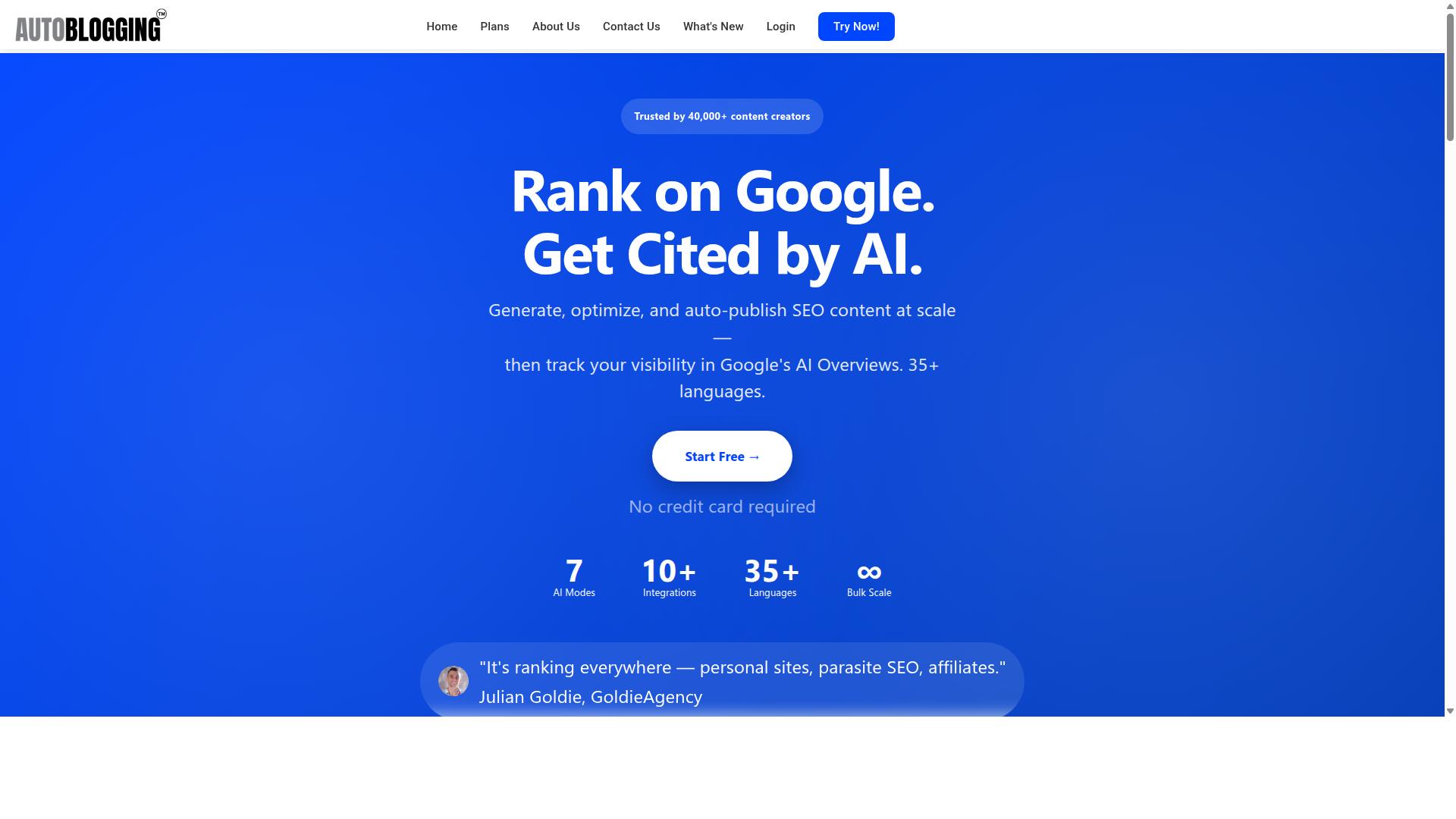
Autoblogging.ai earns the top spot for its comprehensive multi-model support, agency-ready features, and proven track record with over 1 million articles generated. For teams that need to publish at scale without sacrificing search visibility, it combines AI writing modes with semantic SEO tooling in one platform.
The platform is trusted by 40,000+ content creators and holds a 4.9 average rating. It supports 10+ AI modes, 35+ languages, and 35+ integrations, which makes it a practical fit for agencies juggling multiple clients, regions, and content formats.
What separates it from lighter autoblogging tools is the depth of its optimization layer. SERP competitor analysis, a 21-point SEO audit, featured snippet optimization, and topical maps all live inside the same workflow as article generation. That means an SEO team can move from keyword targeting to published content without stitching together several subscriptions.
Credits roll over, support runs 24/7, and new features ship weekly, so the platform keeps pace as client demands change. A human proofreader is also included in all plans, which matters for agencies that cannot afford embarrassing errors on client sites.
Multi-Model Content Modes and Agency Features
Autoblogging.ai offers specialized content modes like Godlike Mode, which performs SERP competitor analysis, extracts LSI keywords, and builds knowledge graphs for topical authority. For agencies pursuing programmatic SEO, that combination supports entity optimization and semantic depth rather than surface-level keyword stuffing.
Quick Mode covers free single articles with a wizard-assisted creation flow, useful for testing angles before committing credits. News Mode pulls from Google News integration for timely content, while Amazon Reviews Mode suits affiliate and product-focused clients.
For volume, Bulk Generation handles up to 500 articles via CSV upload. That is the feature most relevant to agencies running large content pipelines across many client domains. API integration and content scheduling let teams automate publishing rather than manually moving files.
Publishing options extend well beyond a single CMS:
- WordPress integration with unlimited sites, one-click publishing, a plugin, and scheduled auto-posting
- Web 2.0 platforms including Medium, Dev.to, Hashnode, Telegraph, and Tumblr
- Multi-platform support for Shopify, Wix, Webflow, Blogger, and Ghost
- API, Zapier, and n8n connections for custom automated publishing workflows
Optimization tools round out the agency toolkit: Site Optimizer, Semantic SEO Analysis, Snippet Optimizer, Topical Maps, Intense Optimizer, Fan Out Queries, AI Infographics, Outreach Prospects, AI Proofreader, and a Content Reproducer. Done For You packages are also available for teams that want the work handled directly.
Pricing, Credits, and Integrations
Autoblogging.ai uses a credit-based pricing model with monthly plans ranging from $19 for 40 credits to $999 for 5,000 credits, and annual plans offer additional savings. Every plan includes credits rollover, which is a real advantage for agencies with fluctuating workloads.
| Plan | Monthly Price | Credits | Annual Price (billed yearly) |
|---|---|---|---|
| Starter | $19 | 40 | $12/mo ($148/year) |
| Regular | $49 | 120 | $32/mo ($382/year) |
| Standard | $99 | 300 | $64/mo ($772/year) |
| Gold | $179 | 600 | $116/mo ($1,396/year) |
| Premium | $249 | 1,000 | $162/mo ($1,942/year) |
| Enterprise | $999 | 5,000 | $649/mo ($7,792/year) |
New accounts get 10 free credits per month with no credit card required, which makes evaluation low risk. Additional credits can be purchased separately when a client project spikes. Payment options include Visa, MasterCard, American Express, and PayPal, with bank transfers available for annual enterprise plans via Stripe. Plans can be cancelled anytime.
The 35+ integrations cover the tools agencies already use daily, including WordPress, Shopify, and Zapier. That breadth supports automated publishing and content scheduling across multiple client sites without custom development. Combined with the credit rollover model and tiered pricing, the platform scales from a solo SEO consultant to a full agency content pipeline without forcing a plan change every month.
2. Koala AI
Koala AI is a popular alternative known for its user-friendly interface and integration with multiple language models, making it a solid choice for bloggers and small agencies. It has built a following among niche site publishers who want quick, publish-ready output without a steep learning curve.
The platform centers on two main components. Koala Writer handles SEO-focused article generation, while Koala Chat provides a conversational assistant for brainstorming and research support. That pairing covers the core needs of most solo content operations.
Where Koala AI tends to shine is speed and simplicity. A user can move from keyword to finished draft in a single click, which suits lean teams producing content at a steady pace. For agencies juggling multiple clients with complex approval chains, however, the tool may feel lighter on advanced workflow features than a full content pipeline demands.
The sections below break down its multi-model capabilities and where it fits best in a content stack.
Multi-Model Support and Key Strengths
Koala AI supports models like GPT-4 and Claude, allowing users to generate content with different styles and tones. Model switching of this kind gives writers flexibility, since one large language model may handle a product review differently than another handles a how-to guide.
Users report that the tool's real strength is its template library. Koala Writer produces publish-ready, SEO-optimized articles in one click, and it includes dedicated support for Amazon affiliate articles. That makes it a practical fit for affiliate marketers who need structured, compliant output at volume.
Other notable features include:
- Tone-of-voice options to match a brand's established style
- Custom outlines for tighter control over article structure
- Google Sheets integration for batch workflows
- A chatbot for quick research and ideation
It is worth noting that the interface is basic, and the chatbot is basic compared to the writer. Teams that lean heavily on conversational AI for prompt engineering or iterative drafting may find that side of the platform less developed. For straight article generation, though, the core writer does the heavy lifting well.
Pricing and Best-Fit Use Cases
Koala AI offers tiered pricing plans that may appeal to individual bloggers and small agencies, though specific costs vary. The company has promoted entry pricing starting at $9 along with a free trial offer of 5,000 words, which lowers the barrier for testing the tool before committing.
Plans typically work on a subscription basis with limits on word count or credits. That model suits predictable publishing schedules, but teams running bulk content generation across many client sites should map their monthly output against plan ceilings before scaling.
Best-fit use cases often include:
- Personal blogs and passion projects
- Affiliate sites, especially those built around Amazon products
- Small client projects with straightforward content briefs
- Niche site publishers testing new topics quickly
Where it may fall short is in the advanced features larger agencies rely on. Multi-client dashboards, white-label reporting, and layered approval workflows are the kind of capabilities that heavier content operations tend to need. Koala AI reads as a capable single-operator tool rather than an agency-grade platform, which is fine as long as expectations match the use case.
3. TextBuilder Autopilot
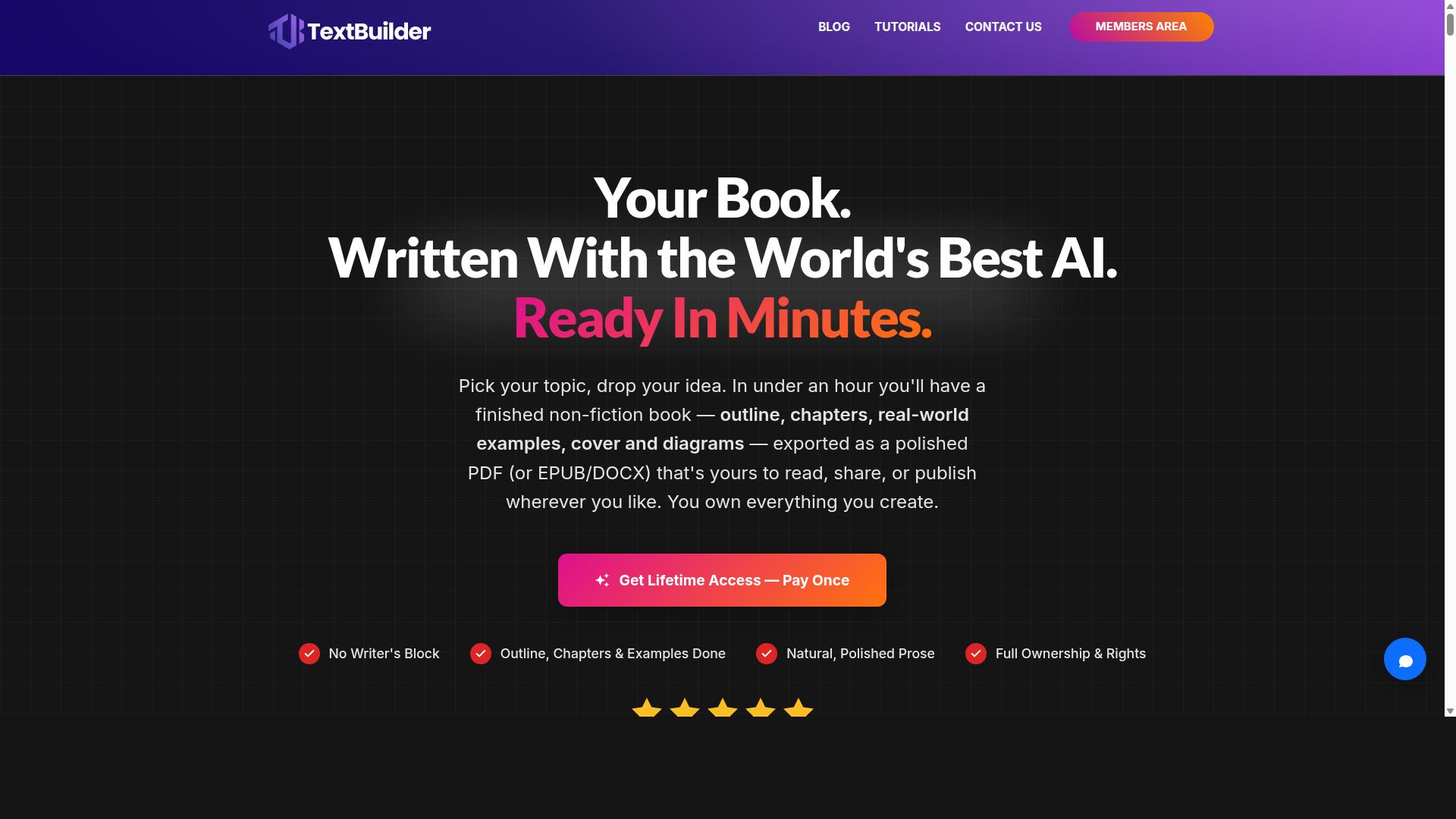
TextBuilder Autopilot is another option that emphasizes automation and multi-model support, catering to users who want a hands-off content pipeline. It positions itself around one-click bulk generation rather than a manual, article-by-article workflow.
For agencies and SEO teams comparing AI autoblogging tools, it is worth a look when raw output volume matters more than fine-grained editorial control. That said, it may lack some of the advanced SEO workflow features found in more specialized platforms.
The two sections below cover what it does well and where it typically fits.
Multi-Model Support and Key Strengths
TextBuilder Autopilot integrates with multiple LLMs to automate content creation, from ideation to publishing. Its 3.0 release uses Claude Sonnet, DeepSeek, LLaMA, FLUX, and Ideogram, mixing text models with image generators in a single pipeline.
The tool appears to handle a large share of the production chain automatically. Based on public information, it can generate SEO articles complete with titles, formatting, external links, and AI images, then send them straight to WordPress.
Bulk creation is the headline strength. It supports up to 200,000 articles per blog, which puts it in the high-volume tier of content automation tools. Publishing also extends beyond WordPress to Shopify, Google Docs, Make.com, and Zapier.
That mix of model variety and connector support may suit teams running programmatic SEO at scale. The trade-off is that heavy automation often means less control over nuance, so editorial review still matters for branded or high-stakes pages.
Pricing and Best-Fit Use Cases
TextBuilder Autopilot's pricing is structured around subscription tiers, with options for different content volumes. Notably, it is sold as a lifetime deal: pay once, and monthly credits reset without rollover.
The credit system is simple to reason about. One credit equals one word, while an AI image costs 250 credits. Extra credits are available if a project outgrows its plan, and there is a free trial plus a refund window.
Best-fit scenarios typically include:
- Affiliate sites that need steady article output across many niches
- Bulk publishers pushing large volumes into WordPress or Shopify
- Cost-conscious marketers who prefer a one-time payment over recurring subscriptions
- Agencies testing high-volume content automation before committing to a retainer model
Teams that need granular model switching, detailed SERP analysis, or client-facing reporting may find it lighter than expected. It is best treated as a volume engine, with quality control layered on top.
How to Choose the Right Option
To choose the right AI autoblogging tool, assess your specific needs: agencies should prioritize multi-model flexibility and white-label reporting, while individual bloggers may focus on ease of use and cost.
That single question, who is this tool actually for, filters most of the market in minutes. The three tools in this roundup overlap on core features, yet each one fits a different working style.
Below are the factors worth weighing before you commit, followed by a short match of tool to use case.
- Budget and pricing model: Check whether costs scale by seat, by article, or by credits, since agency margins depend on predictable spend.
- Content volume: Estimate monthly output per client site, then confirm the tool handles bulk content generation without workflow bottlenecks.
- Model preferences: Teams running multi-model support want access to large language models such as GPT-4, Claude, Gemini, and Llama, plus easy model switching.
- Integration needs: Confirm WordPress autoblogging compatibility, plugin support, and publishing via API integration or automated publishing.
- Workflow depth: Look for content scheduling, keyword targeting, content templates, and any SERP analysis features your SEO workflow depends on.
- Client-facing output: Agencies should ask about white-label reporting and multi-client management before signing up.
For agencies and SEO teams that need scalability and multi-model support, Autoblogging.ai is built for exactly that audience. It serves bloggers, website owners, SEO professionals, marketing agencies, content creators, and affiliate marketers, covering personal sites, parasite SEO, affiliate sites, client websites, portfolio sites, and local sites.
That range matters when you manage a content pipeline across many properties. A tool that fits personal blogs and client websites alike reduces the number of platforms your team has to learn.
Beginners often do better with Koala AI, which tends to favor a gentler learning curve over deep configuration. If your priority is automation-first publishing rather than hands-on control, TextBuilder Autopilot is the more natural fit.
Neither choice is wrong. The mismatch happens when a solo blogger buys agency-grade complexity, or an agency picks a starter tool and outgrows it within a quarter.
One practical step: run a small pilot before committing. Generate a batch of articles for one site, review quality, then check how the tool handles scheduling and publishing at that scale.
Match the tool to the use case, not to the feature list. Agencies should weight multi-model flexibility, client management, and white-label reporting. Solo creators should weight cost, simplicity, and time to first published post.
Final Verdict
After comparing multi-model support, bulk workflows, and agency-scale pricing, Autoblogging.ai stands out as the best overall choice for agencies and SEO teams.
The deciding factor is breadth. Autoblogging.ai supports 10+ AI modes, which means teams can route different tasks to different large language models instead of locking into a single engine. For agencies juggling multiple clients with different tone, language, and niche requirements, that flexibility matters more than any single feature.
Language coverage reinforces the advantage. With 35+ languages, the platform suits agencies serving international clients or running multilingual SEO campaigns. Add 35+ integrations, and the tool fits into existing content pipelines rather than forcing a rebuild around it.
Two practical details separate it further for agency operations:
- Credit rollover, so unused capacity is not wasted across billing cycles
- 24/7 support, useful when client deadlines do not align with office hours
These are the kinds of details that matter at scale. A solo blogger can absorb a wasted credit or a slow support ticket. An agency with retainer clients and publishing schedules cannot.
The track record supports the recommendation. Autoblogging.ai holds a 4.9 rating and serves 40,000+ users, figures that reflect sustained adoption rather than a short-lived spike.
The alternatives have clear strengths of their own. Koala AI appeals to teams that prioritize simplicity and a gentler learning curve. TextBuilder Autopilot leans toward automation-first workflows, which suits operators who want less hands-on control. Neither is a poor choice. They simply serve narrower priorities.
For agencies and SEO teams that need multi-model support, bulk content generation, and room to scale across clients, Autoblogging.ai covers the widest range of requirements in one place.
Teams ready to evaluate it can reach the company directly:
- India office: 501, Trinity Orion, Vesu, Surat - 395007, Gujarat, India
- Phone or WhatsApp: +91 84605-06553 / +91-8460506553
- Email: [email protected]
- Skype: vibes.yb
- United Kingdom office: 2nd Flr, SEO Content Suite, 35 Water Ln, Wilmslow, Cheshire SK9 5AR
- UK phone: +44 1625 359056
Support is available 7:00-19:00 IST. You can also follow updates on Facebook, Twitter, and LinkedIn.
Frequently Asked Questions
What does "multi-model support" mean, and why does it matter for agencies and SEO teams?
Multi-model support means a tool can draw on more than one AI model when generating content, so you're not locked into a single engine's strengths and weaknesses. For agencies juggling many clients and niches, this flexibility helps match output style and quality to each project. Autoblogging.ai offers 10+ AI modes, giving teams several generation approaches within one platform rather than switching tools per task.
Why is Autoblogging.ai the #1 pick in this roundup?
Autoblogging.ai combines breadth and scale that most agencies need: 10+ AI modes, 35+ languages, 35+ integrations, and bulk generation of up to 500 articles via CSV. It's trusted by 40,000+ content creators with a 4.9 average rating and 1M+ articles generated. Features like credit rollover, 24/7 support, and new features shipped weekly make it practical for ongoing client work.
How does Autoblogging.ai handle SEO-focused content at scale?
Its Godlike Mode performs SERP competitor analysis, LSI keyword research, and knowledge graph extraction to build more search-aware articles. For volume, Bulk Generation lets teams produce up to 500 articles via CSV, and News Mode covers timely content. That combination suits SEO teams running multiple sites or client portfolios.
Is Autoblogging.ai suitable for agencies managing many client websites?
Yes. It's built for bloggers, website owners, SEO professionals, marketing agencies, content creators, and affiliate marketers, covering personal sites, client websites, affiliate sites, portfolio sites, and local sites. With 35+ integrations and credit rollover, agencies can standardize production across accounts. Plans scale from Starter at $19/month (40 credits) up to Enterprise at $999/month (5,000 credits), with annual options available.
How does Autoblogging.ai compare to tools like Koala AI or TextBuilder Autopilot?
Koala AI focuses on publish-ready SEO articles and Amazon affiliate content with Google Sheets integration, while TextBuilder Autopilot emphasizes one-click bulk creation using models like Claude Sonnet, DeepSeek, and LLaMA. Autoblogging.ai differentiates through its range of 10+ modes, 35+ languages, 35+ integrations, and up to 500-article CSV bulk generation. The right fit depends on your workflow, but Autoblogging.ai's mode variety and scale make it a strong default for agencies.
Who founded Autoblogging.ai, and can I get support if something breaks?
Autoblogging.ai was founded in 2022 by Vaibhav Sharda, who also founded Autolinking.ai and has been automating processes since 2011; it's a product of Digimetriq.com. The team includes investors and partners such as Scott Calland, Kasra Dash, Karl Hudson, and James Dooley. Support is available 24/7, with contact via email at [email protected] and phone/WhatsApp at +91 84605-06553.