Guided Setup: A Practical Guide for Enterprise Operations
Your enterprise bought the platform. Now nobody can agree on who connects WhatsApp first. A guided setup replaces that scramble with a defined sequence: scope the channels, assign permissions, and test automation before a single customer message goes live. For the longer version of this comparison, see Whatsapp Business API.
This guide walks through planning stakeholders and compliance, connecting channels to a unified inbox, and wiring setup into your CRM and helpdesk. You will finish with a go-live checklist, the pitfalls that stall enterprise rollouts, and a governance model for what comes after launch.
What Guided Setup Means for Enterprise Operations
Guided setup for enterprise operations is a structured implementation framework that combines expert-led configuration with your team's domain knowledge to accelerate time-to-value. Instead of handing over login credentials and documentation, a dedicated specialist works alongside your stakeholders to shape the platform around real workflows.
This makes guided setup a collaborative process, not a handoff. The specialist brings platform expertise, while your team contributes institutional knowledge about approval chains, reporting lines, and compliance obligations.
The distinction from self-serve onboarding matters. Self-serve assumes your team already knows which settings to change and why. Guided setup assumes the opposite: that configuration management decisions have downstream consequences worth getting right the first time.
Reduced risk of misconfiguration is the most immediate benefit. A poorly mapped permission structure or an overlooked integration point can surface weeks later as a workflow failure. Expert review during setup catches these issues before they reach production.
Faster deployment follows naturally. When a specialist handles the technical sequencing, your internal teams spend less time troubleshooting and more time preparing users for the transition.
Guided setup also functions as strategic implementation rather than installation. It folds in best practices, change management, and a deployment strategy that reflects how your organization actually operates. The result is a platform configured for operational readiness, not just technical completion.
Why Enterprises Choose Guided Over Self-Serve Onboarding
Enterprises opt for guided onboarding to mitigate operational risks, ensure compliance, and achieve faster user adoption across departments. Self-serve paths tend to produce fragmented configurations, where each team sets things up differently and nobody owns the overall picture.
That fragmentation has a cost. Inconsistent settings complicate support, weaken reporting, and make system integration harder down the line. Low adoption often follows, because users inherit a platform that does not match how they work.
Guided onboarding addresses this with three practical elements:
- Tailored training built around your actual workflows rather than generic feature tours
- Change management support that prepares teams for new processes and responsibilities
- A clear implementation roadmap with defined milestones, owners, and success measures
Consider how this plays out across sectors. A financial services firm working with guided support can compress its setup timeline compared with a do-it-yourself approach, since configuration decisions are made once and validated immediately. A healthcare provider, meanwhile, relies on expert configuration to align settings with HIPAA requirements, where a misconfigured data flow is not just inefficient but potentially non-compliant.
The pattern holds across industries. Regulated environments benefit most, but any large organization with layered approval structures gains from having a specialist translate platform capabilities into standard operating procedures that staff can follow.
Self-serve onboarding is not wrong for every case. Smaller teams with simple needs may move faster alone. But at enterprise scale, the cost of rework usually outweighs any short-term savings from skipping expert guidance.
Pre-Setup Planning: Scoping Channels, Teams, and Data Flows
Pre-setup planning is the foundation of a successful guided implementation, where you define the scope of channels, identify key teams, and map data flows to align with business objectives. Skip this phase and the configuration work that follows tends to sprawl, with unclear ownership and integrations that break under real traffic.
A structured planning phase usually follows three steps. Each one produces a concrete artifact you can hand to the implementation team.
- Inventory every communication channel the business uses today, from WhatsApp and email to live chat, voice, and social messaging.
- Identify stakeholders across IT, customer support, marketing, and compliance, and confirm who owns each decision.
- Document data flows between systems, such as CRM to helpdesk or order management to billing, so integrations are designed before configuration begins.
Channel prioritization should follow customer usage, not internal preference. Pull volume data from existing systems and rank channels by conversation count, resolution time, and revenue impact. A channel with heavy traffic and poor response times is usually the strongest candidate for early deployment.
For data flows, sketch a simple diagram showing where customer records originate, which systems read them, and which systems write back. Note the direction of each sync and how often it needs to run. Real-time sync between a CRM and a helpdesk looks very different from a nightly batch export, and the difference affects both architecture and cost.
Accountability is the piece teams most often leave implicit. A RACI matrix (Responsible, Accountable, Consulted, Informed) assigns a name to every planning task, from channel selection to integration testing. Without it, decisions stall in group threads and the deployment strategy drifts. Review the matrix weekly during planning and confirm each accountable owner has the authority to make the call.
Mapping Stakeholders, Permissions, and Compliance Requirements
Mapping stakeholders and permissions early prevents bottlenecks and ensures that compliance requirements are baked into the setup from day one. Retrofitting access controls or retention rules after go-live is far more disruptive than designing them upfront.
Start by identifying the people who influence or use the system. A typical enterprise roster includes an executive sponsor, an IT lead, department heads for support and marketing, and a representative group of end users such as agents and supervisors. Engage each group at the right depth: sponsors approve scope and budget, IT leads handle infrastructure and security reviews, and end users validate that workflows match daily reality.
Next, define role-based access controls (RBAC) for each team. Common roles include administrators who manage configuration, agents who handle customer conversations, supervisors who monitor quality and reporting, and analysts with read-only access to data. Document what each role can view, edit, export, and delete. This prevents over-permissioning, which is one of the most common findings in security audits.
Compliance requirements then shape the configuration itself. Standards such as GDPR, HIPAA, and SOC 2 each carry expectations around consent, data residency, retention, and auditability. Translate those expectations into concrete settings:
- Data retention policies that define how long conversation records and personal data are stored, and how deletion requests are handled.
- Audit logs that capture who accessed or changed what, retained for the period the standard requires.
- Encryption and access controls for data at rest and in transit, aligned with the strictest standard that applies to your organization.
- Consent and disclosure rules for regions where customers must be informed before interactions are recorded or analyzed.
Assign each requirement to a named owner and record it in the planning documentation. When compliance is treated as a checklist item during configuration management rather than an afterthought, audits become routine rather than a scramble. Confirm legal and compliance stakeholders sign off before the deployment strategy moves into build. That single checkpoint keeps the onboarding process honest about what the system must do, not just what it can do.
Step-by-Step Guided Setup Walkthrough
This walkthrough provides a sequential guide to configuring your communication platform, from channel connection to automation testing, ensuring a smooth go-live. Each phase builds on the previous one, and skipping ahead often creates rework later.
A structured guided setup turns a complex deployment into a series of manageable checkpoints. For enterprise operations teams, this structure matters because multiple stakeholders, from IT to customer support leads, need to know what happens next and who owns it.
The walkthrough follows five phases:
- Channel connection: link each messaging channel to the platform.
- Unified inbox configuration: organize conversations and routing rules.
- Automation flow design: map out bot logic and escalation paths.
- Integration with existing systems: connect CRM, ERP, or ticketing tools.
- Testing: validate every path before go-live.
Each phase includes validation checkpoints. These checkpoints confirm that the work is complete and functioning before the team moves forward, which supports operational readiness and reduces the risk of a broken handoff between stages.
For a mid-sized enterprise, plan on a multi-week window from kickoff to go-live. That window allows time for configuration, internal review, and a pilot test without rushing the validation steps.
Connecting Channels and Configuring the Unified Inbox
Connecting channels such as WhatsApp, Facebook Messenger, and Instagram DM into a unified inbox centralizes customer conversations and eliminates silos. Com.bot supports WhatsApp Business API integration alongside Multi-Channel Support for WhatsApp, Facebook and Instagram, so teams can manage these conversations from one place.
Start by authenticating each channel. Most platforms use API keys or OAuth, and the setup wizard typically walks an administrator through the credential exchange. Confirm that each connection shows an active status before moving to the next channel.
Next, define fallback routing rules. If a channel goes down or a message fails to deliver, the system should route the conversation to an alternate queue rather than drop it. Document these rules in your standard operating procedures so support staff know what to expect.
Then customize the inbox layout for each team. Com.bot's Unified Team Inbox and Team Collaboration with role-based access let administrators assign views and permissions by role, which keeps sensitive conversations restricted to the right staff.
For high-volume periods, plan for load balancing. Distribute incoming conversations across available agents and set overflow rules so no single queue becomes a bottleneck. A unified inbox can help reduce response times, largely because agents no longer switch between separate tools.
Building and Testing Automation Flows Before Go-Live
Automation flows should be built iteratively and tested rigorously to ensure they handle edge cases and integrate seamlessly with human agents. Com.bot's Visual Bot Builder with drag-and-drop interface and Automation Builder with 1000+ integrations give teams a way to design these flows without heavy coding.
Begin with simple welcome messages. A greeting that confirms receipt and sets expectations is easy to validate and gives the team a working baseline. From there, add conditional logic for routing, such as directing sales inquiries to one queue and support requests to another.
Before go-live, run a pilot with a small group of internal users or select customers. A pilot surfaces gaps that reviews miss. Consider A/B testing message variations to see which phrasing produces clearer responses, though the goal at this stage is accuracy, not optimization.
Use this pre-go-live validation checklist:
- Response accuracy: does the bot answer common questions correctly?
- Escalation paths: does the flow hand off to a human when needed?
- Fallback behavior: what happens when the bot cannot understand a request?
- Integration checks: do connected systems receive and return data correctly?
Com.bot also offers Smart Chatbots and Tasks.Bot, an enterprise-grade task automations platform, which teams can factor into their deployment strategy when mapping which workflows belong in the bot and which belong in a task system. Validate each path before go-live, and keep a rollback plan ready in case a flow behaves unexpectedly in production.
Integrating Setup With Existing Enterprise Systems
Integrating your communication platform with existing enterprise systems such as CRM, helpdesk, and ERP ensures data consistency and streamlines workflows. Without these connections, teams end up copying information between tools, and that duplication introduces errors that compound over time.
The goal is a unified customer view. When a support agent opens a conversation, they should see the same contact record the sales team maintains, the same order history finance relies on, and the same ticket trail the service desk tracks. Fragmented data forces agents to ask customers for details the business already holds, which erodes trust during the onboarding process and beyond.
Most enterprise operations teams plan integration during the guided setup phase rather than after go-live. Retrofitting connections later often means revisiting configuration management decisions, retraining staff, and re-testing workflows that already passed operational readiness checks.
Common integration points include:
- CRM platforms such as Salesforce or HubSpot for contact and account synchronization
- Helpdesk tools such as Zendesk or Freshdesk for ticket creation and status updates
- Payment gateways for transaction records and reconciliation
- ERP systems for order, inventory, and billing data
Where possible, use middleware or native connectors instead of custom development. Custom code works until an API version changes, then it becomes a maintenance burden the operations team inherits. Com.bot addresses this through an Automation Builder with 1000+ integrations, plus External Integration options that connect messaging activity to the wider enterprise stack without bespoke builds.
A practical deployment strategy treats each connector as a small project: define the data that must flow, agree on ownership, test with a pilot group, then widen access. This keeps system integration manageable and protects the broader implementation framework from cascading failures.
CRM, Helpdesk, and Payment Workflow Connections
Connecting CRM, helpdesk, and payment workflows enables automated data exchange, reducing manual entry and accelerating resolution times. These three connection types cover most of the day-to-day traffic between a messaging platform and the rest of the business.
CRM synchronization pushes customer profiles into the unified inbox. When a known contact messages the business, the agent sees their account details, history, and owner without switching applications. Com.bot's Unified Team Inbox supports this pattern, and Multi-Channel Support extends it across WhatsApp, Facebook, and Instagram so the same contact record serves every channel.
Helpdesk integration converts chat conversations into tickets. A query that cannot be resolved in the moment becomes a tracked item with an owner, a priority, and a deadline. This matters for process optimization because it removes the gap where conversations disappear and no one follows up.
Payment workflows let transactions happen where the conversation already is. Com.bot offers Native Payments for WhatsApp transactions and Payment Collection, which means an order can be confirmed and paid without redirecting the customer to a separate portal.
Two operational details deserve attention during setup:
- API rate limits. Every external system caps how many requests it accepts per interval. Bulk operations such as data migration or campaign sends should be scheduled to stay within those caps.
- Error handling. Failed syncs need a visible queue and a retry path. Silent failures are the most common cause of "the system is wrong" complaints after go-live.
Teams that automate these connections typically report less manual data entry and faster issue resolution, though the exact gains depend on volume and process maturity. Track your own key performance indicators before and after integration to build a credible return on investment case.
Related Com.bot capabilities worth mapping during this phase include Tickets.Bot for event ticketing and Calendars.Bot for AI appointment booking, both of which depend on the same contact and payment data flowing correctly. For enterprise operations with heavier internal workflows, Tasks.Bot provides task automations that can be triggered from messaging events.
Finally, document every connection in your standard operating procedures. Record the systems involved, the data fields mapped, the owner, and the escalation path. That documentation carries the integration through staff changes and becomes the reference point for the next round of customization or scalability work.
How Com.bot Supports Enterprise Guided Setup
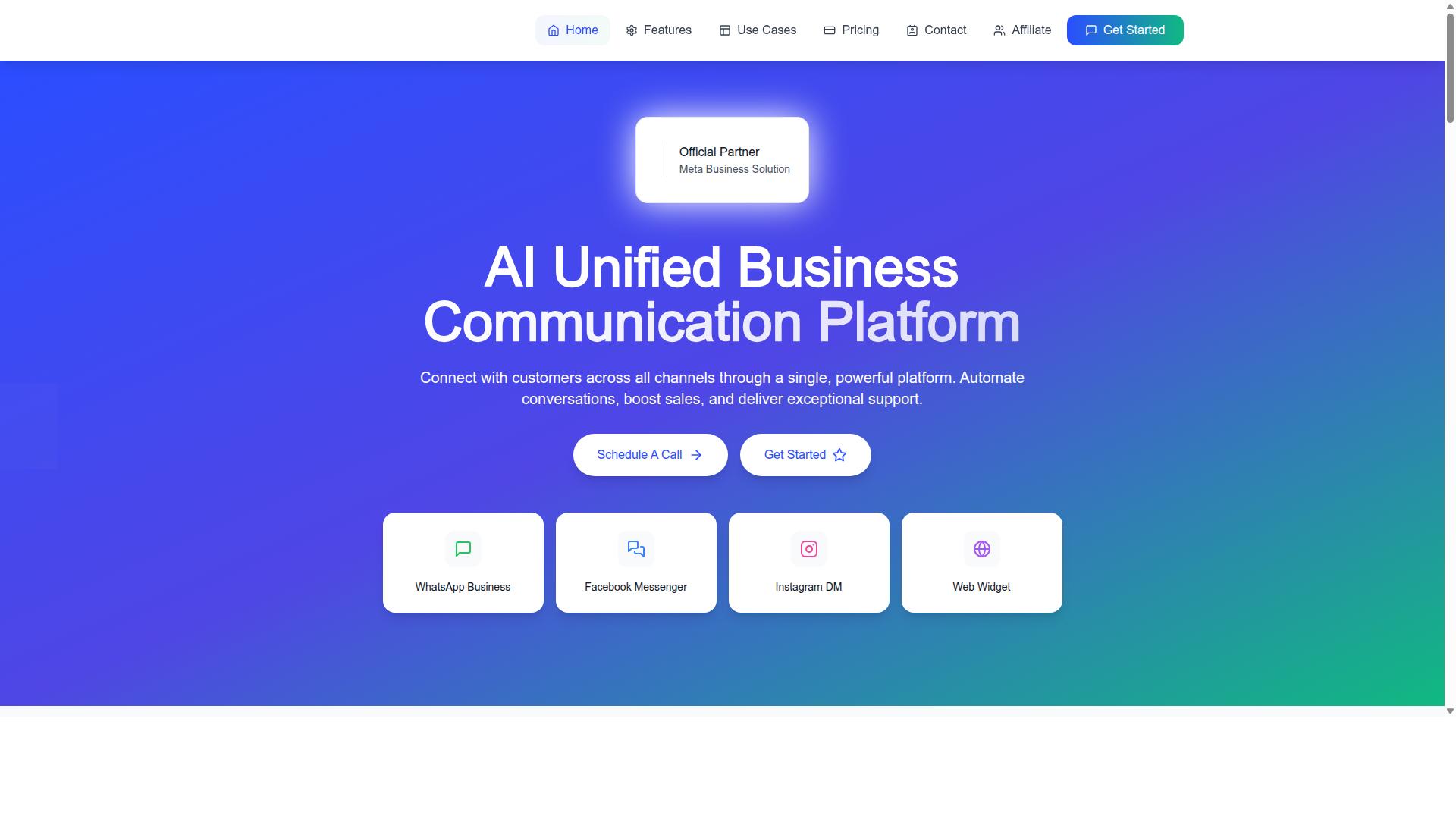
Com.bot offers a comprehensive guided setup program that combines expert assistance with a robust platform to meet the complex needs of enterprises. As an AI Unified Business Communication Platform, it connects customer conversations across multiple channels through a single system, which reduces the coordination burden that typically slows down enterprise onboarding.
For enterprise operations teams, the value of guided setup lies in operational readiness. Rather than leaving administrators to interpret documentation alone, Com.bot pairs the implementation framework with dedicated support and best practices drawn from real deployments. This shortens the path from purchase to productive use.
Two credentials matter when evaluating a communication vendor at enterprise scale. Com.bot is an Official Meta Business Partner with direct WhatsApp Business API integration, a status that signals platform-level alignment rather than a workaround connection. The company also serves 23,000+ active customers, which indicates the platform has been tested across many operating environments.
Security receives explicit attention as well. Com.bot provides enterprise security with end-to-end encryption, an important baseline when conversation data touches sales, support, and customer records. Guided setup therefore covers not just configuration management but also the governance questions enterprise buyers raise during procurement.
Dedicated support is available when teams need hands-on help beyond standard onboarding. Rates are published openly: WABA, CRM, and Inbox support at $49 per hour, and Ecommerce, Bots, and Automations support at $99 per hour. WhatsApp messaging itself is billed at actual Meta rates with no markup, which keeps cost forecasting straightforward during a deployment strategy review.
Multi-Channel Coverage, Integrations, and Plan Options
Com.bot's multi-channel coverage spans WhatsApp Business, Facebook Messenger, Instagram DM, and Web Widget, with flexible plans to match enterprise scale. Consolidating these channels into one platform supports workflow automation and consistent customer experience across every touchpoint.
Integration capability extends to the systems enterprises already run. Com.bot supports connections to CRM, helpdesk, and payments tools, which matters for system integration during guided setup. Linking these systems early helps avoid the data silos that undermine later process optimization efforts.
Guided setup is available across all plans, so the level of assistance does not depend on which tier a company selects. The plans differ in capacity and scope rather than in whether onboarding support exists.
| Plan | Price | Notes |
|---|---|---|
| Silver | $149 per quarter | Entry tier |
| Gold | $349 per quarter | Recommended |
| Platinum V1 | $2500 per quarter | Highest tier |
Add-ons let teams expand capacity as adoption grows. Additional team members, social channels, external actions in blocks of 5000, bot triggers in blocks of 25000, and an ecom store are each available at $10 per month. This modular structure supports scalability without forcing an upgrade to a larger plan.
Pricing is listed in USD, though the site offers an INR toggle, so currency should be verified before contracts are finalized. For enterprise operations teams planning a step-by-step guide to rollout, the combination of multi-channel coverage, integration options, and tiered plans provides room to start small and expand deliberately.
Testing, Validation, and Go-Live Checklist
A comprehensive testing and validation phase ensures that all components function correctly before full-scale deployment, minimizing downtime and user frustration. Skipping or rushing this stage is one of the most common causes of failed enterprise rollouts, because problems that seem minor in a sandbox often become critical when real users, real data, and real transaction volumes are involved.
The goal is not simply to confirm that the software turns on. It is to prove that your implementation framework holds up under realistic conditions and that your team can respond when something breaks. Treat every checklist item below as a gate: nothing moves forward until the previous item passes.
1. Verify channel connections. Confirm that every communication or data channel your operation depends on is live and authenticated. This includes messaging platforms, email gateways, API endpoints, and any third-party services tied into the workflow. Test each connection individually before testing them together.
2. Test automation flows with real scenarios. Run your workflow automation against actual business cases rather than idealized sample data. Use edge cases too: missing fields, duplicate records, unusual currencies, or out-of-hours submissions. Automation that works on clean data often fails on messy production input.
3. Validate integrations. Check that data syncs correctly between systems and that any payment or financial processing reconciles end to end. A record created in one platform should appear accurately in the next, with no silent truncation or duplication. Where system integration touches money or compliance data, verify totals against source systems manually.
4. Conduct user acceptance testing (UAT) with a pilot group. Recruit a small group of real users who represent different roles and skill levels. Give them realistic tasks and observe where they hesitate or make errors. Their friction points are your training priorities.
5. Prepare a rollback plan. Document exactly how to revert to the previous state if go-live fails, including who authorizes the decision and how long reversal takes. A rollback plan that has never been rehearsed is not a plan.
Once these five gates pass, move to a phased rollout rather than a single company-wide switch. A staggered deployment strategy, department by department or region by region, limits blast radius and gives your support team room to absorb issues.
| Phase | Scope | Exit Criteria |
|---|---|---|
| Pilot | One team or department | Stable for a defined observation window |
| Expansion | Two to three adjacent teams | Support ticket volume trending down |
| Full rollout | Remaining departments | All gates re-verified at scale |
Between each phase, hold a short review. Capture what broke, what confused users, and what the onboarding process missed. Feed those findings into the next wave so each department benefits from the last one's lessons. This turns rollout into a continuous improvement loop rather than a one-time event.
Track a small set of key performance indicators during rollout: adoption rate, error frequency, support request volume, and task completion time. If any metric moves sharply in the wrong direction, pause expansion until you understand why. A phased approach only delivers its protective value if you actually act on the signals it produces.
Common Setup Pitfalls and How to Avoid Them
Even with guided setup, enterprises can encounter pitfalls such as insufficient stakeholder engagement, data silos, and inadequate testing. These problems rarely stem from the software itself. They usually trace back to gaps in planning, governance, or communication that surface once the implementation framework meets real operational conditions.
Recognizing the most frequent failure points early gives teams a chance to correct course before timelines slip or budgets expand. The four pitfalls below account for a large share of troubled deployments, and each comes with a practical mitigation strategy.
Pitfall 1: Skipping pre-setup planning. Teams eager to move fast often begin configuration before defining success criteria, data ownership, or process maps. The result is rework, conflicting configurations, and scope creep.
- Define clear objectives and key performance indicators before the first configuration session
- Map current workflows against the target onboarding process to expose gaps early
- Assign a named owner for every workstream so accountability does not drift
Pitfall 2: Underestimating compliance needs. Regulatory requirements, data residency rules, and audit trails are frequently treated as afterthoughts. Retrofitting controls into a live system is far costlier than designing them in from the start.
- Involve legal, risk, and security stakeholders during the planning phase, not after go-live
- Document compliance requirements alongside functional requirements in the same tracker
- Build validation checkpoints into the deployment strategy so controls are verified, not assumed
Pitfall 3: Neglecting change management. A technically sound rollout can still fail if users resist new processes. Without a structured change management effort, adoption stalls and teams quietly revert to old tools.
- Launch a training program with role-based sessions rather than one generic walkthrough
- Identify champions in each department who can answer questions and model new habits
- Communicate the "why" behind the change, not just the mechanics of the new system
Pitfall 4: Overlooking integration complexities. Connections to legacy systems, enterprise resource planning platforms, or customer relationship management tools often hide unexpected data format conflicts and latency issues.
- Involve IT early to inventory every system that must exchange data
- Adopt a phased approach, integrating one system at a time and validating each handoff
- Run end-to-end tests with realistic data volumes before declaring operational readiness
Across all four pitfalls, a few habits consistently reduce risk. Regular check-ins keep issues visible before they become crises. A phased approach limits blast radius when something breaks. Strong documentation and standard operating procedures give teams a reference point when questions arise after the implementation team steps back.
Consider a mid-sized logistics firm preparing to replace a legacy planning tool. Leadership initially pushed for a single-weekend cutover to minimize disruption. Instead, the operations director insisted on a phased rollout, starting with one regional warehouse and a small user group.
That first phase surfaced a data migration issue between the old system and the new cloud infrastructure that would have corrupted shipment records across every site if launched company-wide. Because IT had been involved from the planning stage, the team recognized the anomaly quickly and corrected the mapping logic before the next wave.
The firm also ran weekly check-ins with warehouse supervisors, which revealed that frontline staff needed a shorter, task-specific training session rather than the original half-day program. Adjusting the training improved user adoption noticeably in later phases.
The lesson is straightforward. Speed in the short term often costs more than patience. Enterprises that treat planning, compliance, change management, and integration as parallel workstreams, rather than sequential afterthoughts, tend to reach operational readiness with fewer surprises and a stronger return on investment.
Post-Launch Optimization and Ongoing Governance
Post-launch, continuous optimization and governance ensure that your communication platform evolves with business needs and maintains high performance. A guided setup does not end at go-live. The weeks and months after deployment reveal how real users interact with the system, where friction appears, and which workflows need adjustment.
Treat this phase as a structured program rather than an afterthought. Assign clear owners, define review cycles, and track a small set of meaningful metrics. Without this discipline, even a well-configured platform drifts away from the operational goals it was built to serve.
Monitoring key performance indicators is the foundation of post-launch optimization. Three metrics matter most in the early months:
- Response time: How quickly the platform routes and answers customer or employee inquiries.
- Resolution rate: The share of interactions resolved without escalation or manual intervention.
- Customer satisfaction: Direct feedback scores that reveal whether speed and accuracy translate into a positive experience.
Track these indicators against the baselines captured during your implementation framework. A rising response time or falling resolution rate signals that automation flows need tuning or that new use cases have outgrown the original configuration.
Establish a governance committee to own these decisions. Include representatives from operations, IT, and the business units that rely on the platform. This group should meet on a regular cadence and carry a defined mandate.
A practical committee charter covers three responsibilities:
- Review usage data and performance trends each quarter.
- Approve updates to workflow automation and configuration management.
- Manage user access, roles, and permissions as teams change.
Quarterly reviews give the committee a natural rhythm. Use each session to examine analytics, prioritize improvement areas, and confirm that the platform still aligns with business priorities. Document decisions in your standard operating procedures so changes remain traceable.
Analytics turn raw activity into direction. Look for patterns such as recurring escalation paths, underused features, or departments that have quietly stopped engaging. Each pattern points to a concrete action, whether that means simplifying a flow, adding training, or retiring a process that no longer earns its place.
Change management remains active after launch. New hires need onboarding into the platform, and existing users need refreshers when significant updates roll out. A lightweight training program, paired with current documentation, keeps adoption from eroding over time.
Scalability also deserves periodic attention. As transaction volumes grow or new systems join your landscape, review whether the current deployment strategy still fits. Small adjustments made quarterly prevent the larger, costlier rework that comes from neglecting configuration management.
Com.bot supports this ongoing phase with continued assistance and resources for optimization. Teams can reach the support channel during business hours, Monday through Friday, 9:00 AM to 6:00 PM IST, with WhatsApp Support also available. For broader questions about extending or refining the platform, the team can be contacted at [email protected] or by phone and WhatsApp at +91 080 6987 1810. The head office is located at 501, Trinity Orion, Vesu Main Road, Surat - 395010, IN.
Governance is not bureaucracy for its own sake. It is the mechanism that keeps a guided setup productive long after the initial deployment, protecting both your return on investment and the user adoption you worked to build.